As Taiwan enters an aging society, one of the biggest challenges faced by elderly family members or individuals with mobility issues is the safety of going up and down stairs. Traditional staircases in townhouses, apartments, or multi-level homes are often steep and narrow, making them high-risk areas for falls.
Stairlifts are assistive devices specifically designed to address this issue, allowing the elderly and those with limited mobility to travel between floors safely and effortlessly, while enhancing both quality of life and home safety.
1. What Is a Stairlift?
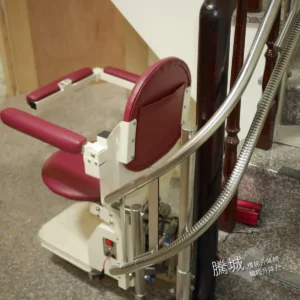
A stairlift is a motorized chair installed along a rail on a staircase. The user simply sits on the chair, fastens the seatbelt or safety bar, and presses a control button, allowing the chair to move smoothly up and down the stairs.
Key Features:
- No major renovation required: Only the rail needs to be installed, without altering the existing staircase structure
- Suitable for various stair types: Can be customized for straight, L-shaped, U-shaped, or spiral staircases
- Easy to operate: One-button control makes it simple for elderly users
- Space-saving design: The seat and footrest can be folded away, allowing others to pass easily
For families who wish to preserve their existing home layout without installing an elevator, a stairlift is an efficient and practical solution.
2. Safety Features: Protecting Every Step on the Stairs
Safety is the top priority in stairlift design. Most models are equipped with multiple protection features to reduce the risk of accidents:
- Obstacle detection: If there is an obstruction on the rail, the chair will automatically stop to prevent collisions or injuries
- Seat Belt (Bar) and Safety Interlock: Different stairlift models may use either a seat belt or a safety bar to secure the user and prevent slipping. Our product adopts a safety bar design, which allows the lift to operate only when the armrest is lowered, enhancing both stability and convenience during use.
- Battery backup: Equipped with a built-in battery that, when fully charged, allows the stairlift to travel up and down the stairs during a power outage.
- Emergency stop function: Both the unit and the remote control are equipped with emergency stop buttons
- Soft start and stop: Ensures smooth movement, preventing sudden acceleration or abrupt stops that may cause discomfort
3. Who Needs a Stairlift?
Stairlifts are ideal for individuals with mobility challenges or anyone who needs safer assistance when navigating stairs:
Seniors and elderly individuals: Those experiencing reduced strength, knee joint degeneration, or a history of falls
Elderly who prefer to stay at home: Those who don’t want to relocate but are concerned about stair-related risks
People with limited mobility: Individuals with mild physical disabilities or those recovering from surgery
Wheelchair users: Optional features such as foldable footrests or platform stairlifts are available
Residents of multi-level homes: Especially in townhouses, apartments, or loft-style homes with three or more floors
Families with elderly members or children: Enhances overall household safety

4. Daily Use and Maintenance Tips
Regularly inspect the rail and seat
Clean dust and debris to keep the rail running smoothly
Check that the seat, footrest, and armrests are secure
Proper operation and usage habits
Teach elderly users the correct operating procedures
Educate children on safe behavior around stairlifts
Always fasten the safety belt to prevent slipping
Maintenance and care
Perform regular servicing according to the manufacturer’s recommendations
Keep the battery adequately charged
If you notice unusual noises or unstable operation, stop using the stairlift immediately and arrange for inspection

5. Stairlift Installation Process
To help users understand the full process, the stairlift installation steps can be summarized as follows:
On-site measurement and assessment
Professional technicians visit the home to measure the staircase length, angle, and width to determine the most suitable stairlift model.Selection and customization
Based on the staircase type (straight, L-shaped, U-shaped, spiral, etc.) and household needs, a customized rail and seat design is prepared.Rail installation
The rail is securely fixed along the staircase, typically without altering or damaging the existing structure, preserving the original layout of the home.Seat installation and testing
The seat unit is mounted onto the rail, followed by operational testing to ensure smooth and safe movement.User training
Family members are instructed on proper operation, including the use of safety belts or safety bars and emergency stop functions, ensuring safe daily use.
6. Stairlift Purchasing Recommendations
Before purchasing a stairlift, consider the following factors to help you choose the most suitable product:
- Load capacity and dimensions
Ensure the seat has sufficient weight capacity. Pay attention to the difference between rated load and maximum load—the rated load is the safe working capacity. Also check whether the seat width fits the user’s body size, and whether the footrest size provides stable support. (See stairlift specifications for reference.) - Wheelchair requirements
If the staircase is wide enough, you may consider a more advanced solution such as a stairlift platform system. Depending on household needs, you can choose a medium-duty or heavy-duty wheelchair platform stairlift. - Rail and wheel quality
Check whether the rail wheels are made of durable stainless steel and whether the rail itself is a solid, high-strength structure for long-term stability. - Safety design
Confirm whether the system includes an emergency stop button (and test whether it stops smoothly), anti-slip footrests (or optional anti-slip pads), obstacle detection sensors, and protective covers for the rail mechanism. - Control method
Ensure the control panel and remote are simple and intuitive, making it easy for elderly users to operate. - Foldable and storage design
Check whether the seat and footrest can be folded when not in use, and whether the parked position does not block other family members’ passage. - After-sales service
Confirm whether the supplier provides regular maintenance, spare parts replacement, and repair services to ensure long-term reliability.
7. Convenience of Stairlifts in Daily Life
A stairlift is more than just a safety device—it also enhances daily convenience:
Transporting items: Elderly or mobility-impaired users can safely carry meals, groceries, or other items up and down the stairs.
Independence in daily life: Reduces the need for family assistance, allowing users to maintain their autonomy.
Reduces stress and worry: Family members can feel assured about the safety of their loved ones when using stairs.
Adds long-term value to the home: Supports future household safety and long-term care needs, benefiting the entire family.

FAQ
Does a stairlift take up space after installation?
The main space occupied is the distance between the rail and the staircase handrail. When using 304 stainless steel for the rail, it is strong and resistant to breakage, allowing the rail to be installed as close to the handrail as possible. This helps maximize the usable staircase space.
What happens if the seat encounters an obstacle?
It is equipped with a safety sensor system. If the base of the unit encounters an obstacle, it will automatically stop to prevent collisions or pinching injuries.
Can it be used during a power outage?
The product has a built-in battery, so as long as it is fully charged, it can continue to operate without being affected by a power outage.
Can children use it?
It is recommended that children use the stairlift under parental supervision. Parents should also teach them about potential hazards to prevent accidental misuse that could lead to danger.
How often should maintenance be scheduled?
Conclusion
A stairlift is not a luxury item, but an investment in improving quality of life and safety.
It helps solve the problem of difficulty in going up and down stairs, reduces the risk of falls, and provides peace of mind for family members. With advancements in technology, stairlifts are becoming increasingly smart, safe, and lightweight, making them suitable for most residential environments.
If you have elderly family members with limited mobility or are concerned about stair safety at home, consider installing a stairlift. It can make your home safer and more accessible, while allowing your family to live more comfortably and freely.

✅ Cityfly Generational Stairlifts for every situation and every person, tackling the most difficult stairway challenges.

Contact us with LINE